The Collections
Ordinary and typical specimens, arranged in sequence. The objects that taught, in his own phrase, rather than surprised.
~22,000
Founding gift, 1884
50,000+
Owned in his lifetime
600,000+
In the museum today
Selected objects
A few of the pieces that carry the collection's meaning.
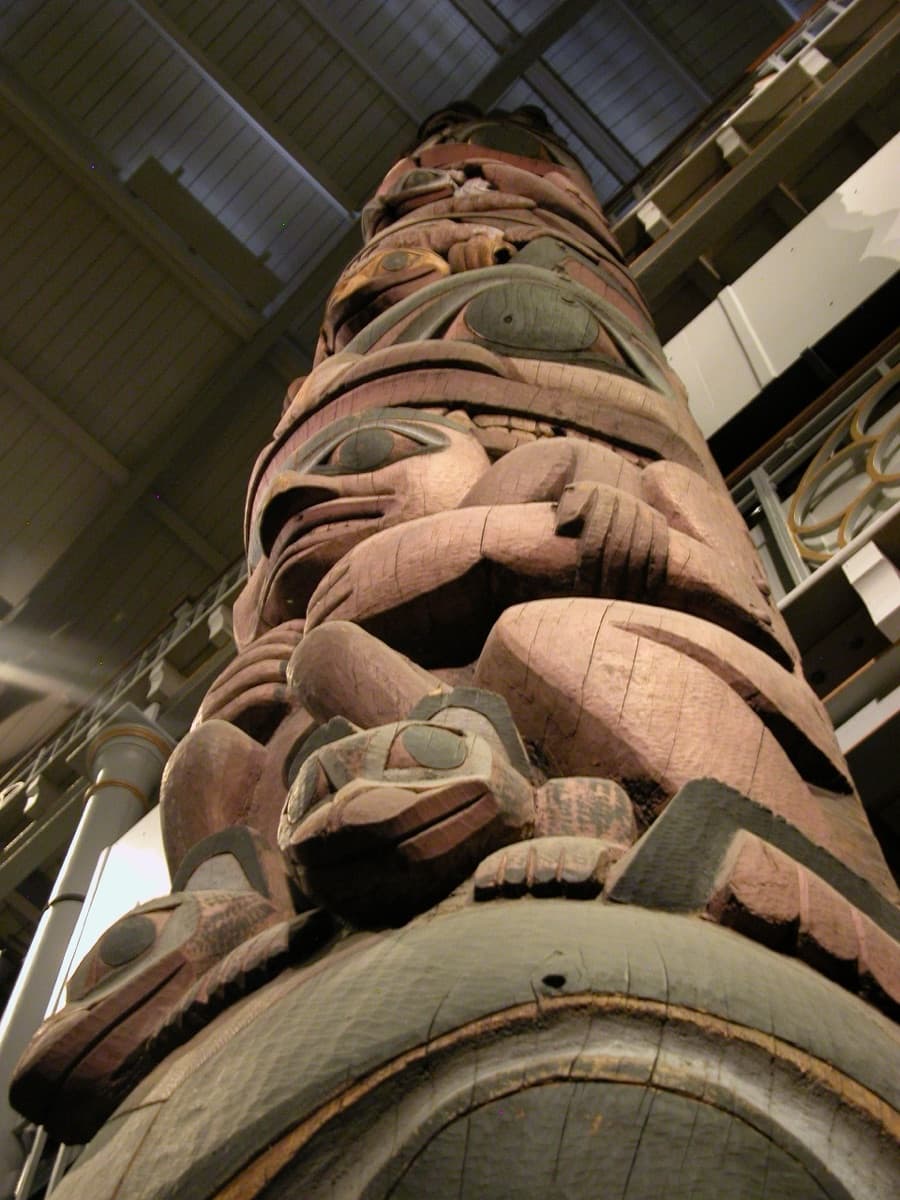
The Star House Pole
Culture Haida, Haida Gwaii
Material Cedar wood
The museum's largest object: an 11.36-metre totem pole from Massett, Haida Gwaii, acquired in 1901 and installed in the museum's entrance court. It remains the centrepiece of the Pitt Rivers Museum.
Benin works of art
Culture Benin Kingdom, Nigeria
Material Brass, ivory, wood
Some 240 works purchased in 1898 after the British punitive expedition, the second-largest Benin collection in the world, catalogued in Antique Works of Art from Benin (1900). In February 2025 the museum transferred ownership of 72 objects to Nigeria, retained on long-term loan.
The firearms series
Culture Worldwide
Material Metal, wood
The founding sequence: the successive improvements of the rifle from which his entire theory grew. Arranged to show the evolution of the form, they are the genesis of the typological museum.
Ethnographic series
Culture Worldwide
Material Varied
Ordinary and typical specimens rather than rare objects, arranged by type, with weapons alongside weapons and looms alongside looms, to trace 'the succession of ideas by which the minds of men in a primitive condition of culture have progressed from the simple to the complex.'
The founding principle, in his words
"For this purpose ordinary and typical specimens, rather than rare objects, have been selected and arranged in sequence, so as to trace, as far as practicable, the succession of ideas by which the minds of men in a primitive condition of culture have progressed from the simple to the complex, and from the homogeneous to the heterogeneous."